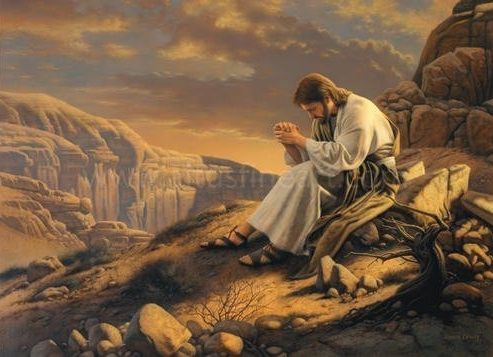
The Spirit immediately drove him out into the wilderness. And he was in the wilderness forty days, tempted by Satan; and he was with the wild beasts; and the angels ministered to him. Mark 1:12-13
We begin the season of Lent by recalling how, immediately following His Baptism in the Jordan, Jesus Christ is lead out into the wilderness (or the desert). It is there that Christ spends forty days before He returns to Galilee to begin His ministry and call His disciples.
Lent is derived from the Middle English word lente, which means ‘springtime,’ which is descended from the Old English lencten. Often, we will hear the word Lenten, which means ‘of or relating to Lent’ and also ‘meatless.’ There is also another word that may be familiar to some used as a synonym for Lent – Quadragesima. This comes from the Latin quadragesimus, which means ‘fortieth.’
It is interesting that the root word of Lent should carry the meaning of springtime, given the image most closely associated with the Lenten season is that of Jesus alone in the desert. How could a desert, so dry, barren, and isolating, evoke any thought of springtime, when flowers blossom, trees regrow their leaves, and new life springs forth?
Well, there is a springtime in the desert. It is just not one that is visible. This springtime takes place internally, within the soul.
For forty days, we must venture out into the wilderness with Christ so that our souls can be purged from all that is holding us back in our spiritual life, in our relationship with God. We must be freed from all our vices, all that leads us into sin. Of course, as human beings who are subject to concupiscence and to falling again and again, it is unlikely that we will be completely purged of all vices and sin by the end of these forty days. But we can assuredly attain greater freedom from these obstacles in our spiritual life than we had at the outset of our journey into the wilderness and a deeper relationship with Our Lord.
And so, we must imitate Christ in His forty days of desert isolation. This does not mean we literally have to go out into the middle of a desert and sit there for forty days without food and water. What it means is that we must spend time over these forty days following the three pillars of Lent: prayer, fasting, and almsgiving.
When Jesus came to the end of His forty days in the wilderness, Satan came to Him to tempt Him. Given Jesus had been fasting, Satan probably thought this was the best time to strike as He would be weak from not eating or drinking for forty days. He presented to Christ three temptations: turning stones into bread, bowing to him with the promise of bestowing on Christ the kingdoms of the world, and putting God to the test by jumping from the temple roof with the presumption that the angels would save Him.
Each of these three temptations are overcome by each of the three pillars.
The first temptation, transforming stones into bread, is the lust of the flesh. In this context, lust of the flesh does not refer simply to sexual sin, but to any bodily pleasure that tempts us to sin – in this case, desire for food, which could lead to gluttony.
The second temptation, where Satan offered Jesus all the kingdoms of the world if He bowed down to him and worshipped him, is the lust of the eyes and the pride of life. Satan promised to give Jesus the ‘glory’ of these kingdoms, which included all the things they contained within them, and ruling over the world clearly appeals to pride.
And the third temptation, whereby Satan suggested to Jesus that, since He was the Son of God, He should throw Himself off the temple and that the angels would save Him if He did, again goes to the pride of life, given the devil wanted Christ to exploit His divine authority. It also goes to the sin of presumption – that God will save us no matter what.
Here’s how the three pillars of Lent help us to overcome the three great temptations.
Pride of life is overcome by prayer. When we pray, we acknowledge our dependence on God. We acknowledge that we cannot do anything without Him. Often, when we try to do things on our own, we make a mess of them and end up finding ourselves crawling back to Him for help. Our recognition through prayer that we rely upon God and are dependent on Him increases the virtue of humility within us and helps us to ensure that we do not become prideful and turn away from His loving care.
Fasting helps us to overcome the lust of the flesh. When we fast, we deprive ourselves of all bodily pleasures. We might choose to give up certain foods or drinks that we like, things that would bring us fleeting pleasure. While many of us will abstain from meat on Fridays, we can take this further in various ways, whether it be abstaining from meat a few days of the week, or maybe even fasting throughout the day on a Friday until our evening meal.
But while fasting from food and drink is good, we can also fast from other things that lead us to sin. We might fast from watching television, or from social media and scrolling on our phones. We could fast from becoming angry with others, from losing our patience, from being judgmental, from becoming embittered. Our goal really should be to target those things which either cause us to sin or which are themselves sinful, so that we can at the very least reduce sources of temptation in our lives.
Fasting is important because it teaches us and increases within us the virtue of temperance. It becomes an avenue for control – as we grow more and more used to going without the pleasures that we are depriving ourselves of, we are able to gain a greater degree of control over them and our desire for them. When we fast, we strengthen our will, so that we can better resist temptation.
The lust of the eyes is overcome by almsgiving. When we engage in almsgiving, we are able to become increasingly detached from worldly objects. We can give charitably to those who are in need and reduce what we purchase ourselves to only those things which are essential. This does not mean solely just giving money to others, although this is certainly part of what almsgiving is. We can also give time to others to help them in any way they need.
When we engage in prayer, fasting, and almsgiving, we are better able to deal with temptations when they come. And they will come. Because when the devil sees us working to turn away from sin, to strengthen our wills so that we can repel it, to grow closer and deeper in our relationship with God, he will strike and attempt to bring us back down. It is when we are growing in holiness that the devil comes to tempt us. But don’t be put off by temptation. Because temptation means you’re doing something right. The devil does not need to tempt those who are already deep within sin and not seeking the forgiveness of God. He does not need to tempt those who are already his. He tempts those who are God’s in an effort to cause them to fall so that they may turn away from God. But through the practices we engage in during Lent, we can ensure we are better equipped to resist the suggestions Satan tempts us with and send him away with nothing.
Prayer is at the root of that. When Satan begins to tempt you and makes a suggestion, turn to prayer immediately so that you avoid contemplating the suggestion and purge it from your mind. It can be a prayer you make yourself, or you might pray an Our Father or a Hail Mary. Any prayer can help to prevent a temptation from progressing into sin.
When we observe the Lenten practices and make changes in our lives throughout the season, it truly can become a springtime for our souls, whereby the virtues can begin to bloom. But if we want them to continue to grow, we need to keep nourishing them. They are like flowers – without proper nourishment and maintenance they will begin to lose their colour, wilt, and die.
That is why, if we want to continue to grow in the virtues, in temperance, charity, humility, wisdom, fortitude, prudence, justice, chastity, faithfulness, patience and so forth, we need to make sure that what we practice during Lent continues after the season concludes.
Consider this: Jesus was born of the Immaculate Virgin Mary. His Blessed Mother was the Immaculate Conception. She was conceived without Original Sin. She had to be, as the Mother of the Lord, the Mother of the Saviour who would offer Himself up as the perfect sacrifice on what would become the new Tree of Life, had to be a perfect vessel with no impurity. Thereby, Jesus Himself, being the perfect, unblemished sacrifice, born of the Immaculate Conception, was also without Original Sin. Christ had no concupiscence, and so He never would have been tempted by what Satan offered Him.
You may wonder then: Why would Jesus put Himself through forty days of fasting and isolation in the desert if He could not be tempted anyway?
It all goes back to fulfilling the salvation of man, and also providing an example for us to imitate so that we can attain that salvation.
Jesus prayed constantly throughout His forty days in the desert. This period of isolation took place right before He was to call twelve men to follow Him, men who He would teach, instruct, and nourish before sending out to do the Will of the Father. Among other things, Jesus likely prayed for those He was going to call. In praying and fasting, He was showing us what we must do to avoid the temptations of this world and become more like Him.
But Jesus’ time in the wilderness is better understood in the context of salvation. In Mark’s short and sharp account of this part of the life of Christ, he writes of something that is unique to His Gospel: ‘he was with the wild beasts, and the angels ministered to him.’
While there are several accounts of individuals with wild beasts in the Old Testament, Mark’s account of Jesus with the wild beasts points us back to Genesis, to the very beginning, when Adam was in the Garden with the wild beasts. And this leads us to the Fall. In the Fall, Adam and Eve were tempted by Satan. They saw that which was forbidden to them by God, the fruit of the Tree of Knowledge of Good and Evil (lust of the eyes), and they desired to eat of it (lust of the flesh) after Satan suggested to them that in eating of it they could become like God (pride of life). In the Fall, each of the three great temptations were put before man, and man succumbed to each, thereby condemning himself to the clutches of sin and death.
We know that Jesus is the ‘New Adam.’ So, just as Adam was tempted by Satan in the Garden and was overcome, it was necessary, in order to right Adam’s wrongs, for Christ to face those same three temptations and to overcome each of them.
Once we understand this section of the Gospel in the context of Genesis and the Fall of Man, we can see the greater purpose that Jesus Christ’s forty days in the desert serves.
During this Lenten season, let us spend time with Jesus in the wilderness, taking the time to reflect, to spend time in prayer, to give alms, and to fast, especially from those things which cause us to stumble. Let us hold fast to the pillars of Lent and purge ourselves from all that is holding us back from growing in virtue and in our relationship with God.
When Jesus concluded His time in the desert, He went into Galilee and began preaching the Gospel, telling the people of the town that the Kingdom of God is at hand.
When we conclude our time in the wilderness, let us do as Christ did. Let us go out into the world and share the Gospel with all others so that they may come to know God and to love Him. Let us use this time of Lent to prepare ourselves so that we can be faithful and effective disciples of Jesus Christ and make disciples of all the world. And may we continue to grow in the virtues and the graces of God.
 JJ’s Outlook