This week, the Church will celebrate the most significant week in the liturgical year. Catholics will venture through the events of Holy Week, recalling the week of Passover almost 2000 years ago when Jesus Christ entered into the final few days of His Earthly life and accomplished the mission bestowed on Him by the Father, the salvation of the world.
Many of us can often take this week and its events for granted. We think we know all there is to know about Holy Week and the Sacred Paschal Triduum, and so we just attend the celebrations because it’s part of our Easter routine. Some of us might even just think about how long we’re going to be in Church for this week, knowing that the liturgies will be lengthier than usual.
But there is so much more to the events that we commemorate during Holy Week. I hope that some of the details to follow will help to enrich your experience of this incredible week of Jesus’ life, suffering, death, and Resurrection.
Emerging from our 40 days in the desert, we enter straight into Jesus’ triumphant entrance into Jerusalem on Palm Sunday. Before Christ enters his hometown, the place that has turned against Him – “a prophet is not welcome in his own home” – He tells His disciples to go into the town and retrieve a donkey that is tied up. This donkey, which Christ enters the city upon, has not been ridden upon, alluding to Christ’s kingship. In this way, He also demonstrates that He is the true Son of David, but also shows His humility, riding in on a donkey rather than a horse or the like. Zechariah 9:9 prophesies this kingly entrance:
Rejoice greatly, O daughter of Zion! Shout aloud, O daughter of Jerusalem! Behold, your king comes to you; triumphant and victorious is he, humble and riding on a donkey, on a colt the foal of a donkey.
And again, Jesus’ choice of entrance hearkens back to Jacob’s blessing to Judah:
Binding his foal to the vine and his donkey’s colt to the choice vine, he washes his garments in wine and his vesture in the blood of grapes. (Genesis 49:11)
And in another way, Christ’s entrance on the unridden donkey alludes all the way back to Genesis, to the Creation of the world. Just as Adam, when he was created by God, was given dominion over all the wild animals, so too does Jesus now have dominion over the wild animals (in the form of the unridden colt).
As Jesus enters Jerusalem, a crowd is gathered around Him, laying down their clothes and palm branches and shouting, “Hosanna.” This word literally means, “save us now.” The people shouting this phrase clearly understand that Jesus is the Messiah, the One who has come to save them (albeit they do not realise that in order to accomplish this mission of salvation the Messiah will have to die a horrible death).
The waving of palm branches also alludes back to the Old Testament. In Leviticus, Moses instructs the people of Israel on the celebration of the Festival of Booths:
And you shall take on the first day the fruit of goodly trees, branches of palm trees, and boughs of leafy trees, and willows of the brook; and you shall rejoice before the Lord your God seven days. (Leviticus 23:40)
Again, in the first book of Maccabees, palm branches are used when Simon Maccabeus liberates the citadel during the Maccabean Revolt:
On the twenty-third day of the second month, in the one hundred and seventy-first year, the Jews entered it with praise and palm branches, and with harps and cymbals and stringed instruments, and with hymns and songs, because a great enemy had been crushed and removed from Israel. (1 Maccabees 13:51)
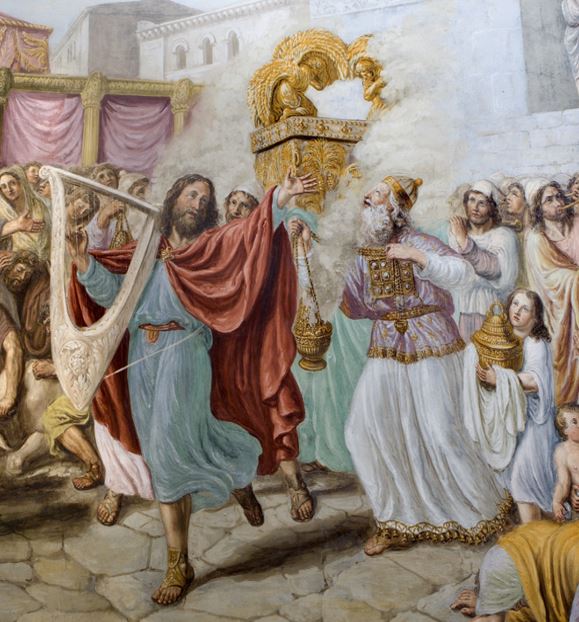
The procession of Jesus into Jerusalem is also similar to the procession that would take place for the dedication of a Temple in the Old Testament. In this case, the procession of Christ is for the dedication of the New Temple, Christ Himself.
I think it is quite common among Catholics to question why these people who celebrated as Jesus entered Jerusalem on Palm Sunday would, just a few days later, condemn the very same man at whose arrival they were overjoyed. This is something I have even questioned, especially in more recent years.
It is thereby important to note that the crowd that celebrates Jesus’ arrival and the crowd that calls for Jesus to die are not the same crowd. Those who were present at the entrance on Palm Sunday consisted of Jesus’ disciples and all those who had been following Him after He visited their towns and cities. Those who called for His execution were scared of Jesus and His teachings, incited by the religious leaders – the Pharisees, High Priests, and Scribes.
Following this, Jesus is anointed by an unnamed woman at Simon the leper’s home, essentially in preparation for death. Over the next couple of days He curses the fig tree and then cleanses the Temple, driving out the money-changers. It is in His reasoning for doing so, in which He begins to refer to Himself as something more than just a man, that the Pharisees see an issue with the Lord and decide to undertake a plot to kill Him.
It is here that Judas enters the picture. Judas makes the deal with the religious authorities to betray and hand over Jesus the day before the Last Supper. When asked about the preparation for the Passover, Jesus, knowing all and likely knowing that Judas had already struck a bargain with the Temple authorities, tells only a couple of His disciples to go find a man carrying a jar of water. He does not tell Judas, as Judas, if having prior knowledge of where Christ would be celebrating the Passover meal, would have likely betrayed Him sooner and prevented the Institution of the Holy Eucharist, the New Passover, from taking place.
When Jesus tells the disciples to look for the man carrying a jar of water, He is not sending them on a wild goose chase. In the context of these times, it was unusual for a man to be seen carrying jars of water. Such a man would have therefore been easy to find. This man leads the disciples to the Upper Room where the Last Supper and Institution of the Eucharist take place. This Upper Room is believed to have either belonged to Nicodemus, or to Mary, the mother of John Mark, who is the same Mark who wrote the Gospel. It is likely that this would have been Mary, the mother of John Mark’s house, given the account we receive in Acts when Peter is rescued from prison. After he is freed by an angel, we read the following:
When he realized this, he went to the house of Mary, the mother of John whose other name was Mark, where many were gathered together and were praying. (Acts 12:12)
It is in this verse from Acts too that we come to recognise the Gospel writer Mark within the Biblical text.
In the Upper Room, Jesus does not immediately institute the Eucharist, the New Passover. Rather, He begins by demonstrating to His disciples how they should act after He has gone before them. He washes each of their feet as a servant and then calls on them to serve others as they have been served, to do what He has done for them. The New Commandment, again a perfection of the original Commandments, is given: Love one another as I have loved you.
It is only after showing His disciples how to serve that Jesus sits with them at table and begins the New Passover. Taking bread, He breaks it, says the blessing and speaks the words of Institution that we Catholics are all very familiar with. He then shares the Passover meal, the Eucharist, His Body, with His disciples. After they finish eating, He takes the chalice, again says the blessing, and shares the Blood of the New Covenant, the New Passover, with His disciples.
Before we move on, it is important to highlight here how time was recorded in the Jewish tradition. The Jewish day is not the same as the day we are all used to. The day begins at sunset and ends at sunset. This is how the Sabbath would take place. It would begin at sunset and end the following sunset. Thereby, the New Passover, whereby Jesus would become the perfect sacrifice for all time and put the days of animal sacrifices in the past, began at sunset on Holy Thursday with the Last Supper. It would end by the following sunset with the death of Christ on the Cross.
Another interesting point to note is that the Passover took place on the fifteenth day of the seventh month, known as Nisan. On the tenth day of this month was when the lambs for the sacrifice would be brought forth. Jesus entered Jerusalem on that very day as the Paschal Lamb, the Lamb of God.
Following the Institution of the Eucharist, Jesus and His disciples sing a hymn and then go out to the Mount of Olives. It is here that He tells them:
“You will all fall away; for it is written, ‘I will strike the shepherd, and the sheep will be scattered.’ But after I am raised up, I will go before you to Galilee.” (Mark 14:27-28)
Many may say that the disciples were distraught after the Passion and death of Christ. This is a line of thinking we can easily fall into. Yes, the disciples were scattered – only John was present at the Cross with Christ, most likely because He went to the Blessed Mother Mary – but they were not distraught. After all, Jesus told them that He would go before them to Galilee following His Resurrection.
After Christ prophesies, Peter speaks up telling the Lord that he will not fall away, that he would die with Jesus before denying Him. While we can all aspire to be like this, to hope that we will stand by Our Lord no matter what, it is not always easy. Peter discovered this the hard way. While Christ was speaking with Pilate, Peter was outside denying Him not once but three times just as the Lord prophesied he would. We too can struggle, we too can turn away from Christ. But the wonderful thing about the ever-merciful Lord is that we can return to Him and He will welcome us back with a warm and loving embrace.
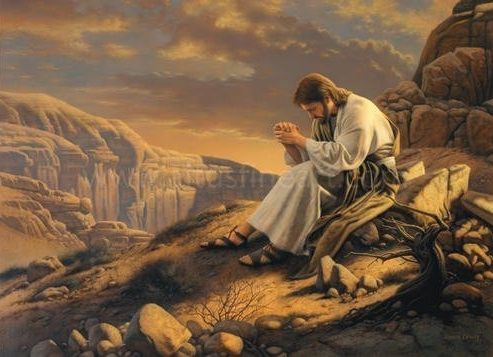
When Christ and the disciples reach Gethsemane, Jesus goes into the garden to pray. And so we have another allusion to the beginning, to the days of Adam in the Garden of Eden. It is here, in the garden, that Jesus brings all things full circle within His Passion in order to bring them back into order with God. In Gethsemane, in the midst of His prayer, Jesus begins to sweat drops of blood. This is a real condition known as hematidrosis, which can occur in individuals suffering from extreme levels of stress. Jesus was under immense stress in Gethsemane, knowing what He was about to endure. It is here that He asks the Father to allow this chalice, the chalice of sin, suffering, and death, to pass Him by. He makes this request three times, yet each time He concludes by uttering the great words of complete surrender:
“Not what I will, but what you will.”
It is by no means easy to surrender our wills to God’s Will. Yet Jesus sets an incredible example for all of us. We must follow in His stead and surrender to God, allowing Him to take over. We may make a request of Him, but each time we should utter those very same words:
“Non voluntas mea, sed tua fiat.” – “Not my will, but your will.”
We should also note here that Gethsemane is derived from two Hebrew words: ‘gat,’ meaning ‘a place for pressing oil (or wine)’ and ‘Shemanim,’ meaning ‘oils.’ Gethsemane was the oil press. The process of pressing olives for their oil took place in three steps, or three presses. The oil from the first pressing was used for the lamp in the Temple. The second press produced the oil used for medicinal purposes. And the third press produced the oil used to produce soap for cleansing.
Just like the olives, Jesus was pressed three times. Each time He prayed to the Father, He was pressed. He was pressed to become the Light of the world. He was pressed in taking our sickness upon Himself so that we could be healed. And He was pressed to cleanse us of sin.
Following the arrest of Jesus after His betrayal by Judas, we find a unique detail in Mark’s account:
And a young man followed him, with nothing but a linen cloth about his body; and they seized him, but he left the linen cloth and ran away naked. (Mark 14:51-52)
There have been numerous theories as to who this young man might have been. Some Scripture scholars have suggested it was John. Others have said it could have been James. However, the third, and most likely, idea is that this young man was Mark Himself. This is his cameo, his ‘Alfred Hitchcock’ moment per se. If we consider that Jesus and His disciples ate the Passover meal in the Upper Room in Mary’s house, and that she was the mother of John Mark, it makes sense that Mark may have heard the commotion and ran out to Gethsemane, which would not have been all that far from the house where Jesus had instituted the Eucharist.
We then proceed through the trial of Jesus Christ. While there is much that occurs here, what with Jesus being brought before the Sanhedrin, then being taken to Pilate, I think it is interesting to consider the role of Pilate. Pilate was a learned man. He was no fool. As a leader in Rome, his duty was to the Romans. He had no obligation to the Pharisees nor the Jewish people in general. When they brought Jesus before him in an effort to have the death sentence pronounced upon Him, Pilate thought it necessary to speak with Christ. It is clear that, from what we see of Pilate in the Passion accounts, He appeared to understand that Jesus was no threat to the Roman Empire. In the eyes of Pilate, He may have been no more than a religious fanatic, one that was not about to start a revolution against Rome.
Pilate, however, was under immense pressure from the crowd to make a decision. He made several attempts to delay, having Jesus scourged in the hope that this may sate the bloodthirst of the crowd (to no avail), and then presenting them with an option to have either Jesus or Barabbas released (again, to no avail, given the crowd demand the release of Barabbas). While the Jewish law was of no great importance to him, the peer-pressure and threats of condemnation from the Pharisees and the crowd put him in a position where he hands Jesus over to be crucified. And yet in making this decision, Pilate, in a paradoxical way, is helping to bring about the salvation of the world.
It is at the Crucifixion of Christ that we encounter a moment that is so Scripturally rich, a moment in which Jesus, from the Cross, points us back to the Scriptures. We see how people mock Him, telling Him to save Himself if He truly is the Christ, the King of Israel, the Son of God. In a roundabout way, they are acting like Satan did at the end of Jesus’ forty days in the desert, presenting Him with the same temptation that Satan did when He told Jesus to jump from the parapet of the Temple, saying that if He is the Son of God He will be saved by the angels of God.
This mockery also points us back to Isaiah’s Songs of the Suffering Servant. Isaiah 50 reads:
The Lord God has given me the tongue of those who are taught, that I may know how to sustain with a word him that is weary. Morning by morning he wakens, he wakens my ear to hear as those who are taught. The Lord God has opened my ear, and I was not rebellious, I turned not backward. I gave my back to those who struck me, and my cheeks to those who pulled out the beard; I hid my face from shame and spitting. For the Lord God helps me; therefore I have not been confounded; therefore I have set my face like a flint, and I know that I shall not be put to shame. (Isaiah 50:4-7)
But Christ also points us towards the Psalms. We are told in the accounts of the Passion that at the ninth hour (again, this is the Jewish timeframe and so would translate to three o’clock in the afternoon), Jesus cried out with a loud voice,
“Elo-I, Elo-I, lama sabach-thani?” – “My God, my God, why have you forsaken me?”
This is not a cry of abandonment by God. In this moment, very shortly before He takes His final breath, Jesus points the people back to the prophetic Psalm of David, Psalm 22. It is essential to understand here that, in Jesus’ time, the people knew the Psalms. They prayed the Psalms like we pray the Our Father or the Hail Mary today. If someone starts it, we know what comes next. In the time of Jesus, if someone began one of the Psalms, the others knew the rest.
So, when Jesus began Psalm 22, the people would have known what came next. Psalm 22 was written by David, and yet it was not about him. The Psalm highlights the Messiah and why He came. It is not a Psalm of abandonment, but both a Psalm of deliverance and of praise to God.
We see in this Psalm the mockery Jesus had to endure from the Cross:
All who see me mock at me, they make mouths at me, they wag their heads; “He committed his cause to the Lord; let him deliver him, let him rescue him, for he delights in him!” (Psalm 22:7-8)
This is precisely what the people who mocked Christ were saying – if God delights in Jesus, let Him save Him from the Cross.
We again see more of Christ’s Passion in verses 16-19:
Yes, dogs are round about me; a company of evildoers encircle me; they have pierced my hands and feet – I can count all my bones – they stare and gloat over me; they divide my garments among them, and for my clothing they cast lots.
‘They have pierced my hands and feet.’ This clearly points to Christ’s Crucifixion, nails driven through both His hands and feet. ‘They divide my garments among them, and for my clothing they cast lots.’ Indeed, just as the Psalm of David prophesied, Christ’s garments were divided up by the soldiers who crucified Him, and when they found His tunic was seamless, they cast lots for it.
The Psalm finishes with the line:
he has wrought it. (Psalm 22:31)
It does not end with suffering, but with praise to God for deliverance. This line can be translated as ‘he has done it’ or ‘it is done.’ This draws us back to Christ’s final words: “It is finished.”
It is these words, in another translation, that point us to the magnitude of the event that has taken place in the Passion, the New Passover – “It is consummated.” What has taken place is not just an eternal sacrifice for the salvation of man, to bring man back into communion with God. It is the greatest wedding of all time – the marriage of Christ, the Bridegroom, to His Bride, the Church. The Last Supper is the Marriage Supper. The Crucifixion, Christ’s embrace of His Cross, is the consummation of the marriage. And now the marriage supper takes place for eternity, and we take part in it each time we participate in the Mass and, hopefully one day, God-willing, at the eternal banquet in the Kingdom of Heaven.
One final point on the Crucifixion of Christ. The day that Jesus died was the same day the lambs for the Passover sacrifice were slaughtered. These lambs were slaughtered at the ninth hour, three o’clock in the afternoon, the very same time that Jesus died on the Cross. Just as Jesus entered Jerusalem on the same day the sacrificial lambs were brought forth, so He became the perfect sacrifice on the same day at the same hour that the lambs were sacrificed. He was the true Lamb, the sacrifice to end all sacrifices. From His side flowed the blood and water of new life, the New Covenant.
Just as Jesus entered Jerusalem on an unridden donkey on Palm Sunday, He was placed in an unused tomb, the Holy Sepulchre, following His Death – again, pointing to His kingship.
But death was not the end for Christ. For when He rose on the third day, our salvation was accomplished, and our path to full communion with God in the kingdom of Heaven was opened. The Resurrection is essential to our faith. For if the Resurrection did not occur, our faith would collapse. Just as the Apostle Paul writes:
But if there is no resurrection of the dead, then Christ had not been raised; if Christ has not been raised, then our preaching is in vain and your faith is in vain. We are even found to be misrepresenting God, because we testified of God that he raised Christ, whom he did not raise if it is true that the dead are not raised. For if the dead are not raised, then Christ has not been raised. If Christ has not been raised, your faith is futile and you are still in your sins. Then those also who have fallen asleep in Christ have perished. If for this life only we have hoped in Christ, we are of all men most to be pitied. (1 Corinthians 15:13-19)
The Resurrection is essential for our path to life. Jesus was not merely raised from the dead like Lazarus or Jairus’ daughter. These individuals were raised, however they were raised only to return to their earthly life only to die again in time. Jesus, however, was raised to new life, a life beyond the constraints of this world. He could thereby appear to us in any way He chose, and He chose the form of bread and wine, the Holy Eucharist.
On Easter Sunday, we will hear the Gospel reading about the disciples on the Road to Emmaus. On the journey, Jesus preaches the Scriptures to the disciples, interprets them, then sits at table and breaks bread with them. As soon as they recognise Him in the breaking of the bread, Jesus disappears from their sight. This is because He is now truly present in the Eucharist. The bread He breaks is now the form He chooses to appear in. The account of the Road to Emmaus contains within it the Mass itself – the Scriptures are proclaimed, the priest interprets the Scriptures in his Homily, and then the bread is broken and transforms, or transubstantiates, into the Body of Christ.
And remember, Easter does not conclude on Easter Sunday. Just as the Passover spanned for a whole week, so too do we have the Octave of Easter, spanning for eight days, and then six Sundays of Easter prior to the celebration of the Lord’s Ascension into Heaven. The Easter season lasts fifty days.
This Holy Week, take the time to consider what is really taking place in each Mass and service you attend. This is the most Scripturally rich and liturgically beautiful time in the liturgical year. Participate fully, be engaged in the liturgy, let it take up all your focus and attention for those few hours it spans. The Sacred Paschal Triduum is not three liturgies – it is one major liturgy that takes place in three parts over three days. There are no Introductory Rites, merely a Collect, on Good Friday and the Easter Vigil, and there is no Dismissal on Holy Thursday and Good Friday. It is all one major liturgical celebration of the Lord’s Institution of the Eucharist, His Passion, suffering, and death on the Cross, and His glorious Resurrection.
This is the culmination of everything we have been journeying towards over this Lenten period. As we journey out of the desert and into the holiest of weeks, the holiest of celebrations, let us take time to reflect, understand, and resolve not only to live as Christ has asked of all of us, but to take up our own crosses, to unite all our prayers, works, joys, and sufferings with His, and journey towards the glory of eternal life.
I pray that you all have a very blessed and spiritually nourishing Holy Week.
God Bless.