You can read my latest piece for The Spectator Australia here: On the latest government hypocrisy on COVID-19.


You can read my latest piece for The Spectator Australia here: On the latest government hypocrisy on COVID-19.
Since the dawn of Western Civilization, there have been key pillars upon which society has been built. One of the most valuable of those is the family. The family represents unity, love, strength, and courage all in one. It is where we begin our journey as human beings in this life, where we are nurtured and raised. It is where we are conditioned to the world around us so that we may interact with society in a socially acceptable manner. It is where we learn how to make good choices, and where we learn right from wrong, where we take our first steps in developing good moral judgement. The family unit is one of the most important, fundamental cornerstones of a functional society. That is why those who have their own “utopian” visions of society (often where they are the ruling party) seek to destroy it. That is why it must be avidly protected.
The concept of family has existed since the very beginning. If we look back on Biblical times, there were many families from the point of Creation onwards. There was Adam and Eve and their sons Cain and Abel, the archetypally opposed brothers, something that quite possibly still exists today. There was Noah, his wife Naamah, and his sons, Shem, Ham and Japheth. There was Abraham and Sarah and their son Isaac. There was Elizabeth, Zechariah, and their son John the Baptist, who would later baptise Jesus Christ Himself. And, of course, there was the Holy Family: Mary, Joseph, and Jesus. Looking back on the beginning, God clearly states his intention for the inception of the family. We can see this if we go back to the Book of Genesis, the first Book of the Bible. In Genesis 2:24, which we discussed in the second Edition of Uncovering Christianity: Suffering, Reflection, and the Power of Love, it is written:
When a man marries a woman, they become united as one. Their hearts and souls entwined in the uniting force of love, a gift from above, they become part of each other, each filling a place in the other’s heart. Marriage is shown to be one of the most important aspects of life, when a man and woman are joined together, and go on to create a family of their own, bearing children and guiding them in their lives to grow into good, socially acceptable human beings who are capable of interacting well with others in society. Biblically, marriage is a one of the seven Sacraments created by God. For those unfamiliar with the Sacraments, they are: Baptism, Holy Communion, Confirmation (these three are known as the Sacraments of Initiation, given they are the three that one will make to become a Catholic), Reconciliation (also known as Confession), Marriage, the Anointing of the Sick (for those who are unwell or facing illness), and Holy Orders (for those becoming Priests). Marriage as described in Genesis 2:24 is perfected by Christ in Matthew 19:3-6 (bold writing is what God the Father said, which Jesus is quoting to remind those whom He is addressing):
Some Pharisees approached Him. They wanted to test Him and asked, “Is a man allowed to divorce his wife for any cause whatsoever?” Jesus replied, “Have you not read that in the beginning the Creator made them male and female, and he said: For this reason a man shall leave father and mother, and be joined to his wife, and the two shall become one body? So they are no longer two but one body; what God has joined together, let no one separate.”
In this, we see that once a man and woman are joined together in marriage, they should not be separated by anyone. They are the roots of the family that is to be created, and not only should they remain faithful to one another, but they should ensure the preserve and protect their marriage by all means necessary. There is a lovely verse that demonstrates just how beautiful marriage is:
As for you, husbands, love your wives as Christ loved the Church and gave Himself up for her (Ephesians 5:25)
By likening marriage to the relationship between Jesus Christ and the Church (referred to as “her”), we can see how it is one of the most precious parts of life, and how we should not take it for granted. We should be prepared to sacrifice for the good of our marriage, putting it ahead of more tangible aspects of our lives.
Following marriage is the creation of a family of our own. This, of course, means children. Children are indeed a gift from God, and, as we discussed in the previous edition of Uncovering Christianity: The Sanctity of Life, they are of great value and should not have their lives taken before they have a chance to live. Children are a significant responsibility that one must take on in their lives. Thus, it is pertinent that you are ready to take on that responsibility before conceiving a child. The most common reason for abortions is inconvenience. This may be due to career aspirations or the like, or just not being prepared to take on the responsibility of caring for a child. Here is a very simple but blunt life lesson: If you’re not ready to take on the responsibility of having a child, do not take the risk. Instead, practice abstinence until you are ready. Do not put irresponsibility nor selfishness ahead of an innocent life.
When you are ready to have children, keep in mind that it is a wonderful thing to have many. You may remember in the edition previous to this one, we discussed the following verse:
Sons are a gift from the Lord; the fruit of the womb is a reward. Like arrows in the hands of a warrior are the sons of one’s youth. Blessed is the man who has filled his quiver with them, for he will not be put to shame when he contends with his foes at the gate. (Psalm 127:3-5)
Having many children is a blessing. Do not be afraid of that prospect. Once you do begin the creation of a family and bring those wonderful bundles of joy into the world, cherish them, nourish them, and nurture them into fine human beings.
It is important that children are brought up in such a way that they are able to interact with others in society so as to build up friendships and relationships and establish a stable societal position. They should be given every opportunity to enjoy their childhood while it lasts, given the world that awaits them as an adult is much more challenging to navigate. But they must also be taught the skills necessary to help them navigate adult life. These skills and life lessons are typically bestowed upon them first and foremost by their parents, but also by their teachers, mentors, friends, and other people who enter and swiftly exit their lives. Sometimes the most valuable lessons are learnt in the most difficult ways. It may be necessary to be hurt in order to learn something that is of immense value to your life and the way you live it.
Parents are, of course, the primary teachers of their children, especially when it comes to social conditioning. Children must be taught from a young age how to behave so that they do not turn others away from them and alienate themselves. They must learn how to discern right from wrong. Parents have the responsibility of guiding their children in the ways of what is socially acceptable. This is again demonstrated Biblically in Proverbs 1:8-9:
Listen, my son, to the teaching of your father, do not ignore your mother’s instruction; for they will be your graceful crown, a precious chain around your neck.
The guidance of a mother and father are of great importance in child’s life. The above verse from Proverbs describes it as something truly special. In providing guidance, a parent adorns a child with wisdom, knowledge, good judgement, and life lessons that they will carry with them throughout their own lives, no doubt one day passing on to their own children.
In return, it is important that children respect their mother and father. In fact, this is one of the Ten Commandments, the ten original rules handed down by God to Moses on Mount Sinai. The Fifth Commandment as written in the Book of Exodus states:
Honour your father and your mother, that you may have a long life in the land that the Lord your God is giving you. (Exodus 20:12)
Just as parents teach their children important values, including those such as respect and honesty, children must show obedience to their parents and show them the respect they have been taught. Your parents are, after all, how you came to be, how you entered the world. You would not be here without them.
The concept of the nuclear family is one that has provided stability to society. For those unfamiliar with the term, the nuclear family is one consisting of a man and woman (husband and wife/mother and father) and their children (one or more). The nuclear family, headed by two loving married parents, is the safest and most stable grounds for raising children. Children need stability in order to grow into good and decent human beings. The nuclear family is the source of stability. It is also a tenet of Western Civilization. That is why it is under attack.
In the modern world, there are forces at play that seek to destroy the nuclear family. They seek to make marriage into something it is not. They seek to corrupt the minds of children, confusing them, turning them against their parents and friends, and transforming them into embittered human beings who are angry at the world and wish to tear down social norms. How we got here is a question that has no doubt played on the minds of many who fight to protect the tenets of society that ensure its stability. It is, however, obvious. The gradual pervasion of evil into this world has brought about these forces. It is therefore pertinent that we discuss them openly so that we can understand just how great a threat they pose to the West.
From the outset, I have made it clear that marriage has always been between a man and a woman. In recent times, certain groups have sought to demolish this millennia-old tradition and replace it with a wider-ranging definition of marriage, that being between two people, regardless of gender. In fact, the legal definition of marriage no longer uses the words “between a man and a woman” but has replaced them with “between two people”. When same-sex marriage began to be pushed several years ago, we were told it was only about marriage, and nothing else. Yet there were many who have observed the traditional idea and values of marriage as presented first by God Himself that warned that marriage was only the beginning. I was one of those people. Our fight was not only to protect the sacrament of marriage, but to prevent any further impinging of radical beliefs and values upon society.
Unfortunately, we were right. Marriage was indeed only the beginning, a way to infiltrate and tear down the values that held together Western Civilization. In the years since, pervasive gender ideology has worked its way into society and, more concerningly, the education system, warping the minds of innocent children whose minds are still in the developmental stages, thereby making them much more susceptible to the ideas pushed upon them by others, in particular teachers, who seek to turn them against all that is good in the world, indoctrinate them with radical beliefs, and recruit them into destructive forces.
One of the most egregious forms of this mind-warping is making children believe that gender is fluid, confusing them and putting it in their minds that they should question their own gender. Biologically, there are only two genders: male and female. This has been the case since humanity’s conception. You are either born male, or female. Again, there are forces who seek to change this biological fact, telling people, including children, that there are dozens of genders and that they can be whatever gender they want. This is not limited to teachers, but also extends to parents. There are some parents nowadays who clearly do not have the best interests of their children in mind. They may see their young son wearing a dress or playing with toys marketed at girls, or it may simply be that he loves the colour pink, and they will say he is actually a girl and treat him as such, confusing the child. Or it may be the case that the child sees an adult who has changed gender or been introduced to this ideology and begins to think that they are the wrong gender, and their parents reinforce this belief. If such a thing had occurred decades ago, a parent would have told their child this is ridiculous, but now it is seen as “brave”.
Here’s the harsh reality that these people need to learn, as put by political commentator Ashley St. Clair: “Your child is not trans because he put on a dress or tried on makeup. My little brother used to eat grass as a kid but my mom didn’t call him a cow and send him to the slaughterhouse. She told him to cut it out and stop eating grass.” Young kids cannot even make simple decisions yet. In most countries, you cannot vote until you reach the age of 18, you cannot drink until you turn either 18 or 21, you cannot drive until around 16, you cannot even get a tattoo until you turn 18. So how can children be expected to decide they are not the right gender? The impacts on the mental health of children who question their gender and end up changing genders are terrible. Many who do end up experiencing a detrimental impact on their mental health, and their risk of suicide increases significantly. Those who do not change gender because this is not indulged by their parents most often end up growing out of it by their early twenties.
What is concerning is how this doctrine has infiltrated the education system, where children go to learn all kinds of things to help them in their lives and careers. Parents likely do not expect their children to be indoctrinated with these kinds of ideologies that in many circumstances alienate them from their children. Now, it would not surprise many that state schools have been affected, however it might that Catholic schools do not have an issue with this ideology pervading their system either. For example, the Catholic Education Office in the Parramatta Diocese, led by Greg Whitby, has refused to support a push to take gender ideology out of New South Wales’ schools. And the Bishop is yet to take a stance. The corruption of the minds of children is dire.
It seems apparent that more is being done to take the faith out of schools then maintain it. As a Special Religious Education (SRE) teacher (otherwise known as Scripture teacher) in State schools, I have seen the incredible impact the faith can have on the lives of children. I have seen the joy it brings to them, the light it brings to their lives. But organisations like the Teacher’s Federation seek to bring an end to this. They have repeatedly said they wish for Scripture to be taken out of school, claiming it takes up class time that could be used for other purposes. I should make it very clear that I will continue to fight against this. Scripture teaching has enriched my life, and I can see it is enriching for the lives of the children I teach.
Jesus Christ makes it clear in His teachings that children are the greatest in the Kingdom of Heaven. This is presented in Matthew’s Gospel:
At that time, the disciples came to Jesus and asked him, “Who is the greatest in the kingdom of heaven?” Then Jesus called a little child, set him in front of the disciples, and said, “I assure you that unless you change and become like little children, you cannot enter the kingdom of heaven. Whoever makes himself lowly like this child is the greatest in the kingdom of heaven, and whoever receives such a child in my name receives me.” (Matthew 18:1-5)
Children are valued by Christ because they are innocent, because they are God’s most precious creation. He goes on to make it clear that no one should lead them astray nor corrupt their minds, saying:
“If anyone should cause one of these little ones who believe in me to stumble and fall into sin, it would be better for him to be thrown into the depths of the sea with a large millstone around his neck. Woe to the world because of so many thinks that cause people to fall! Such stumbling blocks are bound to come, but woe to the one who causes others to fall!” (Matthew 18:6-7)
Corrupting the mind of a child and causing them to stumble and fall is truly a terrible thing to do. Christ Himself tells us children must be protected, and warns us against bringing harm to them, be it physical, mental, or otherwise. Children must not be subjected to pervasive ideology that they may fall victim to, that may tear their lives apart. It is a tragedy to see children preyed upon by forces of evil. We must do all we can to protect our children. That is why Scripture is important. That is why I teach it. That is why I am writing Uncovering Christianity. I will fight for our children, and I hope that others will join me.
The family is one of the most important pillars of Western Civilization. While others may seek to destroy it, to bring it crashing down, we must remember that without it society would lack stability and chaos would ensue. In the absence of the family lies misery, wrongdoing, suffering. When you think of the family, what comes to mind? To me, it is happy faces, love, joy, togetherness, all the best parts of humanity. Sure, we might face tough times in our own families. No family is immune from this. Even the Holy Family, that being Mother Mary, the Blessed St. Joseph, Earthly foster father of Jesus, and Jesus Christ Himself, faced tough times, not least the Passion of the Lord, when Jesus was sent to His Death upon the Cross and died to take away sin, so that we might live with Him for eternity in the Kingdom of Heaven. It is up to us to carry the crosses that fall upon our shoulders within our own families, to navigate them using the wisdom bestowed upon us by our parents, and to do all we can to keep our families intact, no matter what may come between us. Family is everything.
This is the Seventh Edition of a Series entitled Uncovering Christianity: Exploring the Roots of the West. This series explores the values and ideas originating from Christianity, looking back at Biblical times, and relating them to the modern world. There are central themes to each piece in this series, with key messages throughout to guide you in your own life. The series also looks at some of the threats to the roots of Western Civilization and discusses what can be done to placate them and protect the foundation of society. Keep an eye out for new series pieces each week.
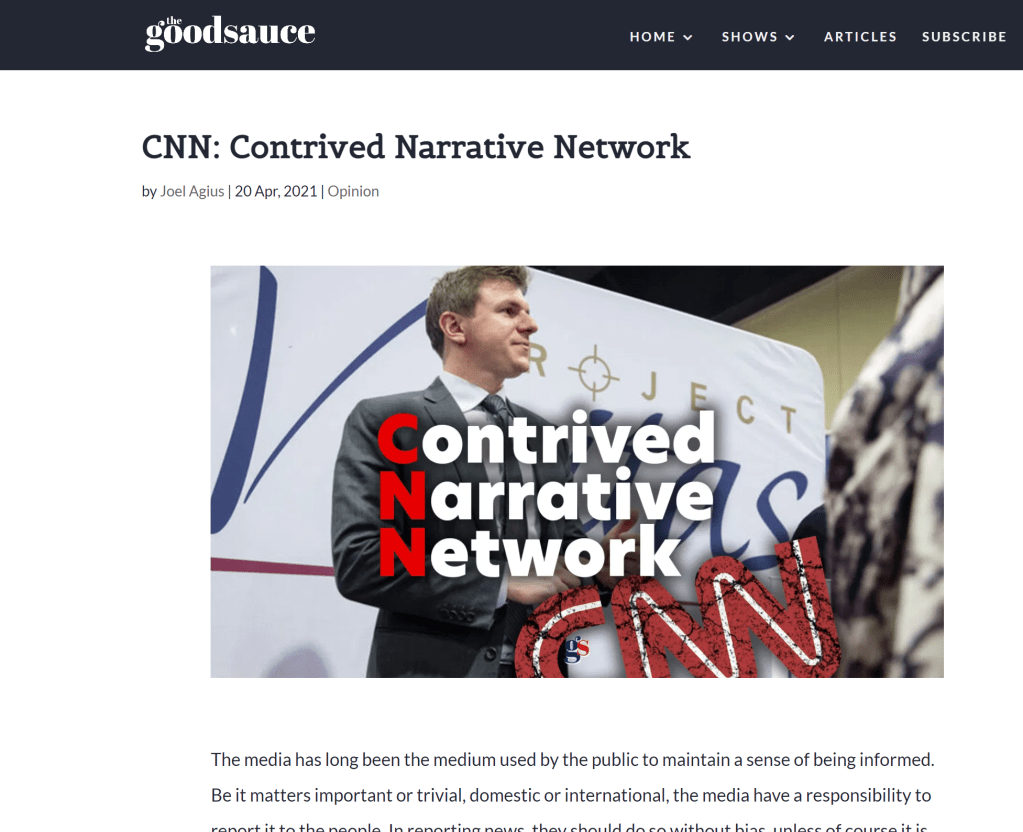
Read my latest piece for The Good Sauce here: On Project Veritas’ exposé on CNN, how it demonstrates a significant breach in media ethics, why CNN have lost all credibility and trust, and how Twitter are protecting them. We desperately need more good and honest journalists in the industry.
Human life is precious. That should go without saying. However, in this day and age, it seems this basic tenet of society has been forgotten, or more maliciously, deliberately tossed aside. The problem that arises is that when we cast aside human life as if it does not intrinsically matter to building and maintaining a decent, thriving society, we also discard the very soul of society itself. Society would not exist without human life. This is why we must make every effort to protect the sanctity of life itself. But how can we do that in a world that has become so desensitized to death, and to the destruction of life even before it comes into existence.
Now I understand people have become wary of others pushing certain views, be they political, religious, or otherwise. I want to make it clear from the outset that while we are going to be discussing issues in this edition of Uncovering Christianity that are polarizing to some, they will be discussed in terms of morality. This series is, of course, one dedicated to looking deeper into Christianity, and so we will be exploring this topic in terms of Christianity and Biblical context as well.
Life itself is one of the most important aspects of this world. In the Christian perspective, life came into existence when it was created by God Himself. As mentioned previously, the world and all it entails, including human life, was created in six days, the seventh being a day of rest. God saw that His Creation, the wondrous expanse of life He had crafted, was good. We will go deeper into the world of Creation in a future edition. When God created human beings, the first being Adam and Eve, he created them in His image:
So God created man in His image; in the image of God He created him; male and female He created them. (Genesis 1:27)
God gave us life. It was our duty to protect it. After God created man and woman in His image and likeness:
God Blessed them and said to them, “Be fruitful and increase in number, fill the earth and subdue it. Have dominion over the fish of the sea and the birds of the sky, and every living creature that moves on the ground.” (Genesis 1:28)
In saying “Be fruitful and increase in number, fill the earth, and subdue it”, it is clear God wishes for man and woman to have children, for more humans to be born, grow, and continue in this cycle, filling the Earth. Human life was looked upon with great regard by God. He created us with a specially dignified status amongst all other creatures on this Earth. And so we were called upon to procreate and protect the sanctity of life itself.
Procreation brings us, of course, to discuss the matter of when life begins, and the polarizing issue of abortion. In the modern world, there are those who are pro-life, and those who are pro-choice. Pro-lifers are those who oppose abortion, holding the view that the unborn baby is a human life from the moment of conception. Those on the pro-choice side of the matter often claim it is a woman’s right to choose whether or not she wishes to give birth to a child she has conceived, and that the unborn baby is not necessarily a human life, often using the terms “clump of cells”, “fetus”, or even “parasite” to describe the innocent life inside the mother’s womb. All of these terms are used in order to dehumanize the unborn baby as a means of justifying destroying it.
Over the years, I have seen two arguments made by those who are pro-choice in reference to the Bible to justify abortion. They will either claim that “nowhere in the Bible does it say anything about abortion”, or they will take a Biblical passage out of context in an attempt to justify their views. Both of these arguments, from a Biblical standpoint, are easily dismantled.
First, let us address the claim that there is no mention of abortion in the Bible. This claim is incorrect. There are several verses that address the matter, although not explicitly. Rather, they address it in a way that is clearly intentioned, but without using the word “abortion” itself. The first, as we have already looked at, is Genesis 1:28. God wished for man and woman to “be fruitful and increase in number”. The only way for them to increase in number would be to conceive a child, or children. In other words, God was in favour of procreation.
Before we move on to the next verse, I would like to take a brief moment to discuss the word “procreation”. In essence, there are two parts to this word: “pro” and “creation”. Procreation practically means “for life”. To procreate is to create life. It is all in the word itself.
The next verse that addresses unborn life is Psalm 139:13-16. It reads as follows:
It was you who formed my inmost part and knit me together in my mother’s womb. I thank you, for I am fearfully and wonderfully made; all your works are wonderful; I know that very well. My every bone was known to you when I was being formed in secret, fashioned in the depths of the earth. Before I took shape, your eyes saw me, and before any one of my days came to be they were written down in your book.
It is a really beautiful verse. It truly brings forth the sanctity of life and puts it on clear display for anyone willing to read and understand what the words mean. (Sidenote: The Book of Psalms is one I would highly recommend reading for anyone who is exploring the Bible and the faith more, even for those just starting out. It is a really wonderful book and shows just how incredible the presence of God is and can be in our lives.) It clearly explains how we each came to be, and how God knew us first before anyone else did. God created us in His own image and likeness, knitting us together in the wombs of our mothers. Each of us are wonderfully made, all with our own unique features and perfect imperfections. It is important to note that this world is not perfect, we are not perfect. But each of us is perfect in our own way, so long as we are living a fulfilling life and working toward our purpose in life. The unborn, innocent human lives created in God’s image and likeness, are perfect. They have not yet been touched by corruption in this world. They are perfect, innocent human lives that must be protected and given every chance to enter this world, just as was intended in their creation.
Oftentimes those who are pro-choice will argue that an unborn baby should be aborted merely because it has some sort of “imperfection”. One that I have heard and seen on far too many occasions is Down Syndrome. Pro-choice individuals would say it is justified to abort a baby with Down Syndrome, just because the baby has Down Syndrome. But how can we in good conscience take a human life simply because it is not what some view as “normal”? A baby with Down Syndrome is no different to any other human life. All human life is equal; That is important to remember. Yes, a baby with Down Syndrome may look different and behave somewhat differently, but that does not change the simple fact that it is a human life. It does not change the fact that it is an intelligent human being, capable of leading a good and decent life here on Earth. In fact, those with Down Syndrome are typically much more emotionally engaged with others and are amazing in their own ways. Just because they have an extra chromosome, a genetic feature that others do not possess, they do not deserve to have their lives taken from them.
Jeremiah 1:4-5 is similar in nature to Psalm 139. It reads:
The word of the Lord came to me saying: “Before I formed you in the womb I knew you, before you were born I set you apart, and I appointed you a prophet to the nations.”
In this verse God is addressing Jeremiah, but it is again clear that He wants us to have life, and that He know us all before we are born, setting us apart from one another, giving us our own special gifts and talents.
The next verse is also from the book of Psalms:
Sons are a gift from the Lord; the fruit of the womb is a reward. Like arrows in the hands of a warrior are the sons of one’s youth. Blessed is the man who has filled his quiver with them, for he will not be put to shame when he contends with his foes at the gate. (Psalm 127:3-5)
This verse shows us that children are a gift from above, that they are valuable. They are indeed one of the greatest gifts from God that we can hope to receive. We should not take them for granted, including when they are not yet born.
Our next verse comes from the book of Proverbs. It reads:
There are six things the Lord hates, seven His inner being detests: the proud look, the lying tongue, hands which spill innocent blood, the depraved heart, feet which speed towards evil, a false and lying witness and the man who sows discord among people. (Proverbs 6: 16-19)
These tie in to the Ten Commandments, which we discussed in the third edition of Uncovering Christianity (Rules And Morality). Of course, the main focus for this edition is the third thing written in the verse above, “hands which spill innocent blood”. As was said from the outset of this edition, human life is precious. Taking a human life is one of the most terrible things one can do. The most innocent of human life is that of the unborn baby in the womb. Taking such a life is spilling innocent blood, a most tragic and reprehensible action.
Finally, we have the most obvious yet often disregarded line from the Bible that is completely and clearly against abortion:
You shall not kill. (Exodus 20:13)
It is simple, yet often it is cast aside as if it does not apply to abortion. The truth is it does. When you take a human life, you are killing someone. Now it is obvious this means we should not kill those who have already been born. Their lives are precious and must also be protected. But if we look at this in terms of the unborn, we can see that the rule also applies to their protection. As we have seen from previous verses cited, an unborn baby is a human life. But for those who are not necessarily religious and do not believe life begins at conception, do not take it from me, take it from science.
When fertilization takes place, an embryo is created with its own unique DNA, its own genetic makeup. It is a human life. Scientists agree. Dr. Maureen Condic, Director of Human Embryology instruction and Adjunct Professor of Pediatrics at the University of Utah’s School of Medicine, has written that “the conclusion that human life begins at sperm-egg fusion is uncontested, objective, based on the universally accepted scientific method of distinguishing different cell types from each other and on ample scientific evidence (thousands of independent, peer-reviewed publications). Moreover it is entirely independent of any specific ethical, moral, political, or religious view of human life or of human embryos.” A study carried out by Steven Andrew Jacobs from the University of Chicago took a sample of 5,502 biologists from 1,058 academic institutions. These biologists were separated into 60 groups, which “assessed statements representing the biological view ‘a human’s life begins at fertilization’”, whereby “each statement was affirmed by a consensus of each group, including biologists that identified as very pro-choice (69-90%), very pro-life (92-97%), very liberal (70-91%), very conservative (94-96%), strong Democrats (74-91%), and strong Republicans (89-94%). Overall, 95% of all biologists affirmed the biological view that a human’s life begins at fertilization (5212 out of 5502).” The statistics from this study demonstrate that biologists from all walks of life, of various political and religious beliefs, agree that human life begins at fertilization (conception).
This makes sense, because basic biology says that when fertilization occurs, a human life is created. From that point forth, that is a human life that will grow, that will develop into a human being. And no, it is not part of the mother’s body. It may rely upon the mother’s body for survival when it is developing inside the womb but is a separate human being.
But it seems today that science has become corrupted by partisanship and ideological bias. The problem that arises is this: basic biology has been forgone by many to push their own political agenda that holds a blatant disregard for human life. People worship scientists as if they are gods, thus inflating their egos and giving them every excuse to push their ideology onto everyone else as “science”. In doing so, real science gets lost in the noise of false ideological “science”. Yes, science has its place in society. But so do basic moral principles.
Pro-choice individuals like to take the Bible out of context to claim that God is also pro-choice and justify abortion. The verse most often used for this purpose is Numbers 5:19-22,27-28. It reads as follows:
19-22: He (the priest) is then to make the woman agree to an oath. He shall say to her: If it is not true that a man has slept with you, that you have gone astray and defiled yourself while under your husband’s authority, then may this water of bitterness and cursing do you no harm. But, if it is true that you have gone astray, and have defiled yourself by sharing your bed with a man other than your husband – here the priest is to pronounce an execration and a curse and say – May the Lord make of you an example of malediction and a curse among your people, making your genitals shrink and your womb swell! May this water of cursing enter your body to swell your womb and to shrink your genitals! The woman shall answer: Amen! Amen!
27-28: After he has made her drink it, if it is true that she has disgraced herself, deceiving her husband, then the water of cursing that goes into her shall indeed be bitte: her womb will swell and her genitals shrink, and she will be a curse among her people. But, if she has not disgraced herself and is clean, then she will go unharmed and will bear children.
The fifth chapter of the Book of Numbers focuses on three things: Expulsion of the Unclean, Restitution for Wrongs, and the Test for Suspected Adultery. The above verses are taken from the section on the test for suspected adultery. It is often misinterpreted by those who are pro-choice. They take it that the bitter water given to the woman will cause her to miscarry. The reason they come to this conclusion is a matter of translation. The original Hebrew terms used were “beten”, which is translated as “stomach”, “abdomen”, or “womb”, and “tsabeh”, which means “to swell”. The Hebrew words for “thigh”, “falling away”, and “wasting away” were also used. Most versions of the Bible stuck to the original translations when they were written. The only two that did not were the NIV and NRSV. The translators of these two Bibles clearly decided to follow Biblical commentary that claimed the thigh falling away was a Hebrew euphemism for miscarriage, with these two Bibles instead stating in these verses from Numbers that the woman’s womb would “miscarry”.
Even if the miscarriage translation was correct, this is not at all a justification for abortion. There is nothing to suggest the woman mentioned is pregnant, and it is clear that an abortion is not being performed. In fact, miscarriage is mentioned in the Bible, but in such a way that the unborn baby’s life is viewed as equal to that of the mother’s. Exodus 21:22-25 states:
If people are fighting and a pregnant woman is hit, so that there is a miscarriage, but she is not injured, the one who hurt her will pay the fine demanded by her husband and sanctioned by the court. But, if there is serious injury you are to take life for life, eye for eye, tooth for tooth, hand for hand, foot for foot, burn for burn, wound for wound, stroke for stroke.
The “injury” referred to in this verse, an injury which is to be compensated for like all others, applies not only to the mother but also to the child. The final nail in the coffin of the argument that abortion is supported by the Bible is this: there is no abortion legislation in Biblical law. Why? Because it was such an unthinkable thing that any woman would want to have an abortion that there no need for the offense to be mentioned. The only rule necessary to prohibit abortions was the 6th Commandment: You shall not kill. The Bible and God are very much pro-life.
And just quickly on the cases of pregnancy from rape and incest (because I know it is something many bring up), these are rare, and we cannot use a minority of cases to justify the majority when it comes to abortion, most of which are sought as a matter of convenience given the baby would cause an inconvenience to the mother in some way, be it stalling her career or her ambitions or the like. Personally, I do not believe an unborn child should have to pay for the sins of someone else, in most cases the father. I understand this may be difficult to comprehend, but there are many human beings born out of rape and incest that end up living decent, if not exceptional, lives. Why should they lose their chance at life because of the way in which they were conceived?
There is one final issue surrounding the sanctity of life that we must touch on: capital punishment, or, as it is widely known, the death penalty. This has become a point of contention even amongst Christians. There are indeed Catholics who support the death penalty, and it is something that I have been at odds with since discovering. As a Catholic myself, I oppose the death penalty for the sole reason that it is the taking of a human life. One of the tenets of our faith is that we should not kill. Nowhere in the Ten Commandments is there an exception to the rule given.
Now it is understandable that people would see the death penalty as justifiable for the worst criminals: Those who commit murder, rape, and other heinous crimes. These kinds of people are indeed vile and do not deserve freedom. But we should not kill them either. That would make us no better than them. Just as a murderer took a life, we would take their life.
I do not understand how Christians, those who live their lives by the moral principles and values of the Bible, can support the death penalty yet oppose abortion. They are both the taking of a human life. All human life is equal. One human life is not above nor below another. We all make choices, some good, some bad, that determine our place on Earth. But none of these choices devalue nor increase the value of our human life. As a Catholic, I believe in a consistent ethic, a consistent value, of life, from the point of conception to the point of natural death. The death penalty devalues life. Human beings are not supposed to be savages. We are supposed to be civilized. The death penalty, however, makes us appear to be the former. If you are going to oppose abortion, you should oppose the death penalty. Likewise, if you oppose the death penalty, you should oppose abortion. Both are the taking of a human life. Both show blatant disregard for the sanctity of human life.
Now I know that it may seem like my Catholic faith biases me against abortion. But the sanctity of life is not a matter of faith. It is a matter of morality. Those whose lives are guided by good and decent moral principles, ones that likely align with the same moral principles of Christianity (as we discussed in the previous edition of Uncovering Christianity: The Anonymous Christian), would likely agree that it is immoral to take the life of an innocent human being, and thus the life of an unborn child. But some may still be uncertain about abortion, or even be of the thought that it is acceptable. So, I want each and every person to ask themselves a question: Is it morally right to take an innocent human life?
Life is valuable no matter who the human being is, no matter their circumstances, no matter their choices, no matter their place in the world. Human life takes precedence above all other things in this world, including money and power. Material things like money and power are only temporary. They do not add nor take away value to human life. Our life on this Earth is not permanent. But we must protect human life no matter what. What increases the meaningfulness of life is love, happiness, hope, faith, charity, peace, all those things that enliven and enflame the heart and soul. Who we spend our lives with can also enrich them and make them worth living. Life is precious. It is a gift. Accept it humbly, protect and defend it, live it well, and do it justice.
This is the Sixth Edition of a Series entitled Uncovering Christianity: Exploring the Roots of the West. This series explores the values and ideas originating from Christianity, looking back at Biblical times, and relating them to the modern world. There are central themes to each piece in this series, with key messages throughout to guide you in your own life. The series also looks at some of the threats to the roots of Western Civilization and discusses what can be done to placate them and protect the foundation of society. Keep an eye out for new series pieces each week.
Christianity is often viewed as solely religious doctrine. But it is more than just a religion. It is a faith. It is a set of moral principles that human beings abide by in order to live a good and decent life. But you do not have to be Christian to live by these principles. There are many individuals out there in the world who do not label themselves as Christian, nor religious, yet hold the same values that are at the very core of Christianity. In the last few months of 2020, I began thinking about these certain individuals, contemplating how, despite not being religious, they still acted like Christians. This was brought on by having a conversation with someone who was not religious but still held the same values attributed to Christianity. I had often thought about it since, and then, at the Good Friday service at my parish, the parish priest discussed what he called the “anonymous Christian” in his homily, and I knew this was something that had to be discussed further.
The anonymous Christian is someone who does not necessarily put a label on what they are, but their values align with those of the Christian faith. They may not be particularly fond of religion. Or, like the aforementioned individual who I conversed with on this matter late last year, they may have an urge, a desire to learn more about Christianity, about the faith. I hope that through my writing, through this series, and in a personal capacity I can provide guidance to those who have this urge to find out more. The Bible is more than just a religious text; it is a way of life. It contains principles, ideas, stories, and lessons that people may find are linked to what they already believe. Christianity is a universal truth. The effect it can have on people when they encounter it, when they are able to see how it links to their own lives and their own beliefs, is difficult to explain. It is one of those things that is really just beyond words.
Sometimes anonymous Christians are more Christian than us Christians. As a practicing Catholic, I do my best to uphold the values of my faith: caring for others, showing kindness, helping those in need, and even teaching kids about the faith and the values we hold as Christians. But I admit even I fall short at times. I stumble, I do or say something that does not align with my values, and I often feel a deep sense of regret, shame, or self-awareness afterwards. That is likely true for every one of us, given none of us are perfect. Sometimes the anonymous Christian espouses our values and puts them into action better than we do. While they are out there living their values and being rewarded for doing so in the joy they experience (much like the women who went to the tomb where Jesus had been laid on the third day to find it empty), we hide away like the disciples did after Jesus’ death on the Cross. Yes, in our hearts we may be good people, but we fail to live out our Christian values and use them to help others, to give back to the world, to give back to God in thanks for the gifts he has given us.
Anonymous Christians may at some point decide that they wish to label themselves Christians and begin to deepen their faith. They might start to read the Bible more, to try to deepen their understanding of Christianity, of the belief system, and of the faith itself. They might decide to consult someone who is knowledgeable in the faith, maybe a practicing Christian. Upon reading the Bible, or looking deeper into the faith, they might begin to form questions that they seek answers to, again possibly coming to those of the faith to ask and obtain those valuable answers. They might have an urge to attend church services, to be a part of a congregation of like-minded individuals and meet others who are on the faith journey. After some time, they might even decide to become a Christian or a Catholic and be baptized and/or confirmed as such. It is quite an incredible feeling being a part of a welcoming and loving community.
Anonymous Christians who want to learn more about the faith and immerse themselves more deeply in it should know that they would not be alone in doing so. Practicing Christians and Catholics are constantly doing the same. We learn more all the time. Take it from me. I was baptized Catholic and have attended mass practically every week since I was a baby. As I grew up, I learnt more about my faith and the values contained within it by discussing it with fellow Christians, by attending scripture classes throughout primary school and scripture seminars throughout high school (I was indeed lucky to attend a public high school that offered the opportunity to connect with the faith, something that is becoming increasingly rare nowadays), by attending mass each weekend, by reading the Bible and asking questions, and by watching others live out Christian values in their own lives. Over the years, I have come to gain a deeper understanding and appreciation for the Christian faith and have learnt how to live a good and decent life maintaining the values that I hold dear.
Even now as an adult I am still learning. I have come full circle in terms of scripture classes, going from taking them as a student to teaching them as an adult, so that other kids will have the same opportunities that I did to grow and understand the faith and shape their lives using Christian values. I may teach them, but I often find myself learning things from them that I never thought of before. I also find myself still having epiphanies of sorts at mass when listening to the homily (that is, a reflection on the week’s readings and gospel given by the priest) or even the readings themselves, suddenly realizing something, connecting the dots somewhere that I had not before. For example, at the Easter Vigil mass this year, we heard the story of Abraham and his son Isaac, who he was going to sacrifice for God. But God, seeing Abraham’s loyalty and fear of the Lord, spares Isaac and provides the sacrifice Himself. This Old Testament reading reflects the New Testament story of Jesus Christ, God’s only Son, who was sacrificed and died to save us from sin. There is a really beautiful Bible verse, John 3:16, that reads:
For God so loved the world that He gave His one and only Son, that whoever believes in Him shall not perish but have eternal life.
Just like Abraham was willing to sacrifice his one and only son, God the Father was willing to do the same, and did so, out of love for His people, even though the people had strayed from Him. Despite having heard these Bible stories many times before, I did not connect the two until just this year, and it amazed me when I suddenly realised the parallels. The incredible thing about the Bible is that the Old Testament foreshadows the New. God’s test of Abraham, ultimately ending in His provision of a ram to substitute for Isaac as the sacrifice, foreshadows the sacrifice of Jesus Christ, whereby God provides His only Son as a substitute for us. There is the story of David, who was rejected by his parents as a child, and later by his son who rejected him as King and attempted to take over the kingdom himself. The rejection David and his ultimate ascension as King foreshadows the rejection of Jesus by the Jews and his ascension to become their
spiritual King. And there is the story of Moses, who led the Israelites, God’s people, out of captivity in Egypt by the grace of God, just as Jesus leads all who believe in Him out of the slavery of sin and death. There was the Great Flood, which God used to wash away the wickedness he saw on Earth in the time of Noah. Just as the Great Flood washed away the sins of old, baptism washes away original sin from each of those who receive it, be it those in the New Testament, or even us today.
One can even go as far back as Creation itself, when God created the first human beings in existence, Adam and Eve. Upon creating the two, God gave them the breath of life, a truly magnificent gift. This first God-given gift foreshadowed the gift He would give the disciples in the New Testament at Pentecost, just after Jesus’ Ascension into Heaven. This gift sent from above, the gift of the Holy Spirit, the breath of God Himself, was bestowed upon each of them, granting them seven spiritual gifts: wisdom, understanding, counsel, fortitude, knowledge, piety, and fear of the Lord (what is now more commonly known as wonder and awe). Each of these seven gifts helps their bearer to live a fruitful and meaningful life, doing good on this Earth just as Jesus did throughout His earthly life.
Wisdom allows us to recognize truth, to understand things from the point of view of God Himself. Understanding allows us to grasp the world around us and the points of view of others, as well as the truths of the Christian faith. Counsel helps us to discern right from wrong and make a good judgement as to how best to act. That is why it is also known as Right Judgement. Fortitude, or more simply courage, helps us to stand up for good and defend our world against evil. Knowledge allows us to understand our meaning, our purpose in the world, and to live up to it. Piety gives us a willingness to worship God and to serve Him and others out of love and the goodness of our own hearts. Finally, fear of the Lord, or wonder and awe, is the precursor to wisdom. It allows us to understand and comprehend the greatness, the awesomeness of the Lord and to understand who we are as human beings and why we are here in relation to God Himself. To put it another way, everything we are is a resultant of the wonder, grace, love, and perfection of God.
These gifts of the Holy Spirit are reflected in the way Christians live their lives. But the Anonymous Christian can also espouse similar ways of living, even to a greater degree than some Christians. They can also be witnesses to the gifts, and may be so inspired, so awestruck that they discover an urge, a desire in their heart, to learn more about the faith and come to allow God to enter their life and their heart, to subsequently watch as He works in His mysterious ways to transform their life, and to deepen their connection with Him.
The Christian faith is built upon a foundation of moral principles and values that many of us in the wider society likely share. You do not have to be a Christian to live by these principles and hold these values dear. These are values that make society a better place, that make the world a better place. They help us to live meaningful and purposeful lives, ones in which the potential of achieving fulfillment increases significantly. If more people live their lives according to these values, the world will be the better for it.
So, to all the Anonymous Christians out there, I want you to know that we see you, we see the good that you are doing, the good lives that you lead, and the positive energy you are putting out into the world. Even though you share the Christian values and principles, you may not wish to put a label on yourself just yet, and that is perfectly fine. But if you have an urge to learn more, to discover the faith and all it holds, then I would highly recommend you do so. It will likely be one of the best decisions you ever make and will surely be worthwhile. If you are seeking a stepping stone per se into the world of Christianity and the Bible, I highly recommend watching Jordan Peterson’s Biblical Series. It is quite well done and is a great starting place for those who have that urge to find out more. Peterson himself is a good example of an Anonymous Christian, given he lives by Christian values and principles. In his case, I think after all the lectures he has given of a Biblical nature, all that he has written on Christianity and the Bible, and all that he has been subject to in his own life, particularly over the last few years, he has come to a point where he is wrestling with God, and, at least from my perspective, is coming to a point where he is willing to accept God into his life. It is something that is clearly an emotional and incredibly reflective journey for him, as it is for many who come to discover God’s presence in their lives.
Peterson has helped many individuals who were wondering or who had no idea at all about the faith to come to begin to understand it and embark upon a journey of further investigation and understanding. Indeed, I would say it is almost certain his work has brought more people into the faith, that it has brought more people to God. And that is truly an incredible thing for any one man to accomplish. It shows just how much of an impact Anonymous Christians can have on those around them, and on the world itself. As a Catholic, I aspire to be able to do the same. But Anonymous Christians should know that they can have an incredible impact on the lives of others, and that should inspire them to continue forth on their path, and to embark upon their own journey of discovery and understanding of the faith. I hope that this series might serve to help you on that journey.
This is the Fifth Edition of a Series entitled Uncovering Christianity: Exploring the Roots of the West. This series explores the values and ideas originating from Christianity, looking back at Biblical times, and relating them to the modern world. There are central themes to each piece in this series, with key messages throughout to guide you in your own life. The series also looks at some of the threats to the roots of Western Civilization and discusses what can be done to placate them and protect the foundation of society. Keep an eye out for new series pieces each week.

