Read my latest piece for The Good Sauce here.

Read my latest piece for The Good Sauce here.
There are times in life when you really wonder what someone was thinking. You wonder what was going through their heads when they did something. The Australian Government’s approach to Big Tech is one such time. What the Government have done probably the worst path they could have taken. It is only going to end in the devastation of the media landscape in Australia. But they do not seem to care. In fact, they are doubling down, calling Facebook’s response “heavy-handed”. Well, they should have expected it to be as such. After all, they cannot say they were not warned. Facebook told them this would happen if they passed this absolute sham of a law. Yet they did it anyway (at least, in the House of Reps. It has not passed the Senate yet, although it is likely to occur.
Now usually when it comes to articles I try to take an objective approach with my own thoughts scattered in between. This time I’m not going to hold back. I’m passionate about writing, I’m passionate about what I do, and what the Government has done affects my work. I, like many other independent Australian bloggers and media, have been caught in the crossfire of a war the Australian Government is waging on Big Tech, particularly Facebook. And I am not happy about it.
But first, an explainer of how we got here. I’m going to try to explain what’s happened to the best of my ability. Essentially, it started with News Corp, owned by Rupert Murdoch, becoming upset about losing ad revenue to Facebook because more people were reading their media outlets’ articles through Facebook. Keep in mind, News Corp (which comprises outlets such as The Australian, The Daily Telegraph, The Herald Sun, The Courier Mail, news.com.au, Sky News Australia, etc.) were choosing to use Facebook to get their articles out there for more people to see and click on. Let me emphasise this again: they chose to use Facebook. They did not have to use it. They were not forced to use it. They made a conscious decision, and it ended up causing them to lose ad revenue. That was their own fault. If they wanted to fix the problem, they should have created their own ad tech and run their articles using it. But instead, they went and complained to the Government. And the Government decided to take action.
The Government decided that the best course of action would be to draft a piece of legislation, called the Media Code, to get tech companies like Google and Facebook to pay outlets like News Corp for using their content. They brought in the Australian Competition and Consumer Commission (ACCC), who recommended it be a voluntary process. But when Big Tech basically refused to budge, as they were entitled to do, the Government took it a step further, and passed the law in the House of Reps, essentially making it mandatory that these companies strike a deal with Australian media outlets. This happened on Wednesday night, and on Thursday morning chaos the fallout ensued. Google decided to strike up a deal with News Corp and pay them for the use of their content. Now Google only did this because it is expedient to them. They have plans to build a massive media empire that will essentially wipe out Australian media. The deal was praised by Treasurer Josh Frydenberg, who thanked Google while scolding Facebook. What Frydenberg and most other politicians do not realise is that this is a deal with the devil. It may look good now, but in the long-term, it will likely create even bigger problems. The government is, in simple terms, out of their depth.
But Facebook were not going to play the way the Australian Government wanted them to, and rightly so. Now let me make something very clear; I’m not defending Big Tech. I criticize them regularly, and a lot of the stuff they do is utterly reprehensible. What Facebook chose to do was in the same vein, but it’s not on them. This one is on the Australian Government. Facebook chose to ban the sharing of all Australian media on their platform. That means you can no longer share articles from media outlets including The Australian, news.com.au, The Daily Telegraph, Sky News Australia, 7 News, 9 News, Network 10, the ABC, The Sydney Morning Herald, The Guardian Australia, The Courier Mail, etc.. Essentially, if it’s an Australian media outlet, it’s not on Facebook. But this doesn’t stop at just the big well-known media of Australia. No, it goes further. That’s where people like me come in.
When this all happened on Thursday, I didn’t really think much of it at first. All that occurred to me was that I wouldn’t be able to share news articles on Facebook anymore, which wasn’t exactly an issue for me considering the only things I share on Facebook are of a personal nature, or links to my blog posts each time I publish a new one. But in discussion with people on Twitter about the matter at hand, and in learning more about it, it suddenly occurred to me that this may actually affect me directly. So, I navigated to my personal Facebook page, and discovered that all my posts with links to my blog articles had disappeared. It then dawned on me that I wasn’t going to be able to share links to my blog on Facebook anymore.
See, this Facebook media ban doesn’t just affect your standard media. It also hits small independent journalists and bloggers like me. When giants like the Government and Big Tech are fighting against each other, we get caught in the crossfire, and we pay the highest price. We don’t have the kind of money or resources that these big media outlets have. They can keep going and maintain their audience easily. But for the little guys, we have to find new avenues of building an audience. Usually, we would rely on social media to assist us in doing this. For me personally, a decent portion of my audience came from Facebook. So, I suppose you could say that this was both irritating and stressful. Allow me to give you a bit of insight into how I get my content out there.
When I write an article and subsequently publish it on my blog, the next step is getting it circulating. The first people to be notified of publication are those subscribed to the blog by email. An email notification containing a link to the newly published article is sent to the email address they used to follow the blog. Following this, I copy the link to the article and post it on Facebook and Twitter with a small explainer as to the content of the articles. People can then click on the link which will take them directly to the article. By pursuing all of these avenues, I am able to widen my reach and expand the potential audience. But when one of those avenues is cut off, as it is now thanks to Facebook’s Australian media ban, I lose a way of getting my articles out there, and the potential audience decreases. In an age of instant gratification, people want to be able to click a link and be taken to its webpage straight away. So, when a social media platform stops people like me, small independent bloggers/journalists, from sharing links to our content, it creates a significant problem for us.
And that brings me back to where the blame lies for this whole fiasco. As I said before, I’m not defending Facebook, but they are not to blame for this. They provided fair warning, and it is their platform. Media chose to use it to widen their reach, then realised it was costing them money and demanded the platform, the same platform they had chosen to join and share their content on, pay them. Facebook was never going to do that. But the Australian Government thought they could force them to. And boy were they wrong.
Yes, the blame for this whole thing lies with the Australian Government. They did the wrong thing. In fact, what they did was utterly reckless. They chose to try to enact a new Australian law on US tech companies. In some sense, it is just plain absurd. The Australian Government have no jurisdiction over US tech companies operating out of Silicon Valley, California. They can pass a media law all they like, but Facebook do not have to abide by it. Indeed, Google do not have to abide by it either. These tech companies know this. So, Facebook knows that the economic and political pressure imposed upon Australia by them blocking their service might just result in the Australian Government backing down. To be quite honest, the Government should back down. Even though Morrison, Frydenberg and co are determined to stand their ground, even going so far as to try to bring the leaders of India and France on board with this, I hope for the sake of independent media in this country that they tear up that legislation and reverse what they have done.
Instead of trying to attack Big Tech directly, the Australian Government should lean on their US counterparts. They should request that the US Government enforce Section 230, antitrust law, and monopoly law. Just a quick rundown of these three things for those who are not familiar. Section 230 of the US Communications Act basically grants Big Tech companies immunity from liability for anything anyone publishes on their platforms. It also allows these platforms to moderate and/or remove third-party material they deem to be either obscene or offensive, as long as this is done in good faith. Antitrust law is a collection of statutes both on federal and state government levels that regulate the conduct of businesses in order to protect consumers from predatory business practices and to ensure fair competition. Monopoly law falls into these antitrust laws, in which monopolies are illegal if they are established or maintained through improper conduct, including predatory and/or exclusionary actions. This is what is referred to as anticompetitive monopolization. If the Australian Government were to lean on the US Government to enforce these laws, then the problem that is Big Tech can be solved. After all, these are US tech companies, and they are beholden to United States law.
But the Australian media are not exempt from criticism here. After all, they did ask for this. They were cheering on the Government for going down this route and threatening to enact a Media Code. Why? Because the media knew this would likely take out small independent journalists/bloggers, people like me, who provide competition for them. They wanted to reduce competition, and what better way to do this than take it out with the help of the Government. What they didn’t count on was Facebook taking them out. Now they are complaining about it, upset with Facebook’s actions. Whether or not they have learnt their lesson is questionable. Although it seems apparent that they haven’t, and they likely won’t. That sort of ignorance is going to tear apart the Australian media industry.
So yeah, I’m not exactly happy with what’s happened. I can’t share any of my articles on Facebook now, be they from my own blog, or from other publications that I have had articles published in (ie. The Spectator Australia and The Good Sauce). I’m not going to let that stop me from writing and publishing articles. But I am asking everyone who reads this blog to please subscribe via email. It is completely free. All you need to do is scroll to the bottom of the page, enter your email in the box, and click “follow”. It’s easy and takes no more than ten seconds to do. After you subscribe, you will receive an email notification whenever a new article goes live. This is how we fend off the fallout of this war between the Government and Facebook.
This is a battle between giants. It never should have happened this way, but it did. People like me got caught in the crossfire, and now we have to save ourselves while big media corporations continue forth with all the money and resources they have at their disposal. We will fight on. I will fight on. But it is important that everyone understands exactly what is going on here. Because far too many people are blaming Facebook and saying the Government’s actions were right. They were not. Most of the media will not understand this because they are the ones who complained to the Government in the first place and set of a chain of events that led to this chaos. What the Government did was wrong. What Facebook did was justifiable and unsurprising. Imagine if you ran a platform that you were making money from which provided everyone with the opportunity to publish and promote themselves and their work. Then those same people who choose to use your platform demand you pay them because they choose to publish their content on your platform. You can understand how ridiculous that is. As I said, I’m not defending Facebook, but I think many would do the same thing they did in the circumstances. If the Government had any sense, they would not continue down this path. Instead, they must secure the market, break up the monopolies that have formed, and put pressure on the US Government to prosecute antitrust laws, so that competition in the market can flourish. The free market is always the best way forward.
I will continue to write and publish articles here, as well as occasionally for The Spectator and more often for The Good Sauce (which you can find at goodsauce.news, and excellent
independent Conservative media outlet with brilliant writers and political/social commentators). Please subscribe via email, share the blog around in your own circles, and if you’re feeling generous, you can support my work at my Ko-Fi page, which I’m linking here: https://ko-fi.com/joelagius1. Any funding that comes from that will go into widening the reach of the blog and expanding it into much more. This blog has been one of the best things I have ever done, and I want to do everything I can to fuel it further. The war between the Australian Government and Facebook may persist, but so will I. Independent media needs a buildup of support now more than ever. So please make sure to keep coming back, keep reading what myself and other independent journalists and bloggers write, keep supporting us. We do what we do to keep you informed, and sometimes to inspire or even entertain. And if you’re a young writer like myself, I encourage you to get writing (or typing) and get your voice out there. Don’t let this latest saga stop you from doing so. We need more young writers in the world.
Thanks all for the ongoing support and God Bless.
You can read my first article with The Good Sauce by clicking here.

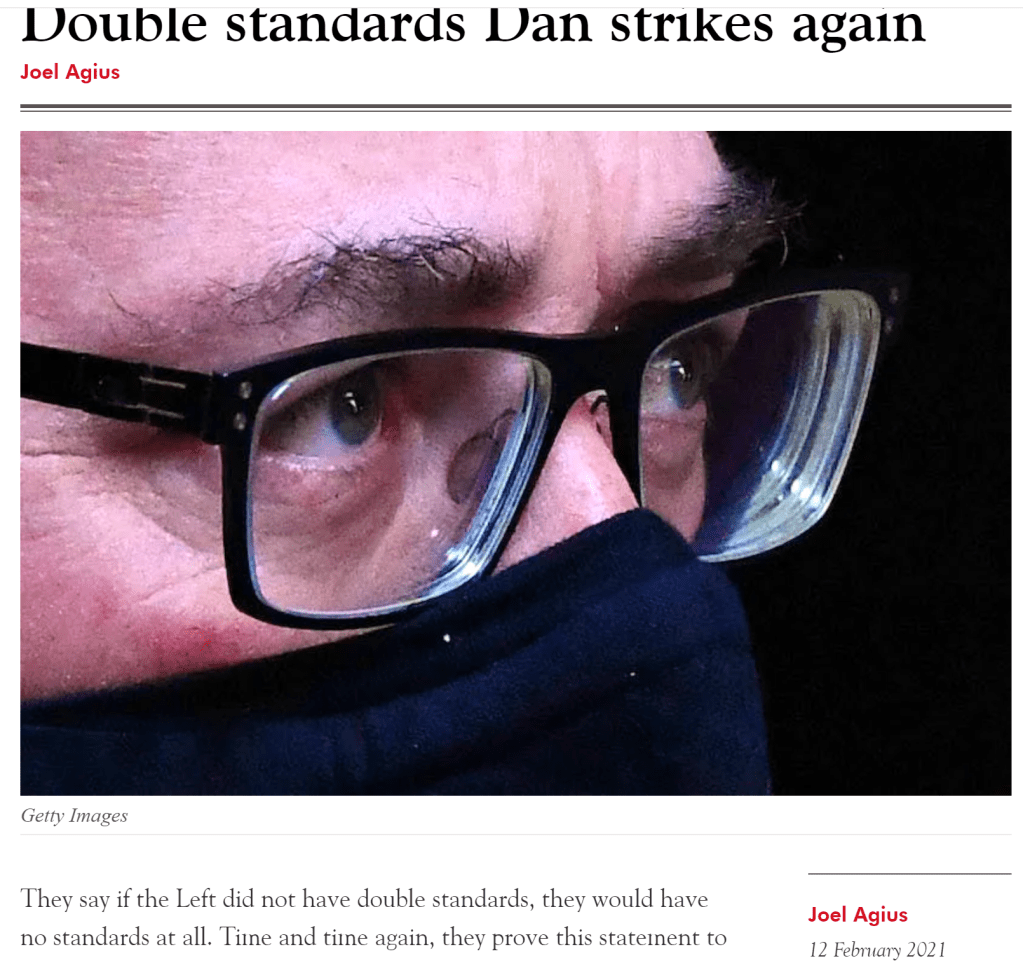
My latest piece for The Spectator Australia “Double Standards Dan Strikes Again” linked here: https://spectator.com.au/2021/02/double-standards-dan-strikes-again/
Music is an incredible thing. It is much more than just sound and rhythm. It is something that speaks to us, makes us feel. It brings out all sorts of emotions. What emotions arise of course depend on the type of music we choose to listen to. Indeed, we may select songs that we can connect with at certain times in our lives. When we’re feeling sad, we might listen to a ballad of heartache or despair. When we’re happy, we might choose an upbeat pop song or the like. When we’re feeling energetic, we might go for a song with a strong beat, something that pumps us up. And then there are times when we might just play any song we feel like to accompany something that we are undertaking (I say this as I listen to a whole range of songs while I write this piece). Music is probably one of the most powerful things in existence, and we are truly lucky to have it. So, I thought it was past time I wrote a piece on it. Let’s explore the power and impact of music a little more.
Music brings people together. A shared love of music can truly unite people, no matter their differences. They could be from different backgrounds, different nations, or of different beliefs and values. But despite the opposition they may hold to each other in the day-to-day affairs of the world, music can bring them together, even if just for a fleeting moment. Some may also find other like-minded people with a similar taste in music, something that no doubt they will be able to bond over. Even if you don’t share the same musical taste, you could still find yourselves moving along to a good beat, a good rhythm. There are a whole range of examples where music has united people as one. Some memorable ones, some of which overlap with the next point on the healing power of music, include charity music events like Sound Relief (for those affected by the 2009 Victorian bushfires), America: A Tribute To Heroes (9/11 Memorial Concert), Live Aid (for those starving in Africa), and more recently One Love Manchester (for the victims of the terrorist attack at the Manchester Arena) and Sound Relief 2020 (for those affected by the 2020 Australian bushfires). All these events brought people together under the unifying banner of music to help those who had been affected by tragedy, disparity, and heartache. The unity seen in these cases was phenomenal. Despite their everyday differences, millions of people rallied together around good causes to help those in need. It just shows the power music has in our world.
That brings us to the healing power of music. Now this is really something. There are times in our lives when each of us face trials and tribulations. We may be struggling mentally; we may be physically hurt. We may be experiencing a loss, heartache, loneliness, anxiety, depression, illness, pain or suffering of any kind. We may be facing down something of disastrous proportions. We may be dealing with something that is overwhelming to us. We may even be connecting with the pain and suffering of someone else in our lives. During these times, things can get dark. It might feel as if storm clouds are constantly sitting right above you, keeping you on edge, unable to focus, unable to contend with the demons you face, unable to heal. Yet oftentimes music can cut through, even if only for a moment. Music can give us that desperately needed relief we crave. Particularly in times of crisis, it can be somewhat cathartic. Throughout 2020, I think many of us would have listened to a lot more music than we might usually do. Being subjected to lockdowns and isolation, music may have been our only friend at times. Indeed, it may have helped us get through these difficult times. Sometimes when we are at our lowest, music can pick us up, even just a little for a few moments. I know for me personally, music has helped me to get through some of the hardest times in my life. It has given me an escape, something that I’ve needed just for a little while, when I’ve been at my lowest, and on occasions where I’ve found myself experiencing a little more anxiety than I would like (sure I’d love none at all, but it lets me know I’m human). I know that even in our darkest hours, when we face the worst, music allows us to just have on moment away from it all.
To demonstrate this, I would like to detail an experience my family had last year. Just before my Pop passed away just over a year ago now, on his last night on this Earth before he left us to go up to Heaven, his kids, obviously all adults now, were gathered in his hospital room keeping him company as he slept. Knowing he was unlikely to make it through the night, they decided to play his favourite song for him one last time. So they put on The Gambler by the late Kenny Rogers, sat with Pop, and listened. In that moment, despite the sadness they all felt knowing their father would only be with them for a little while longer, they found some sense of comfort in the music, in this song that Pop loved so much. Whenever I hear that song now, I think of Pop, I think of that night, his final night here on Earth, with his family surrounding him, I think of the memories we had, and I remember his voice, singing that song he always loved to hear.
And that brings me to my third and what I think will be my final point in this piece on music: memories and emotions. I have decided to combine these two because I think they are linked in nature. Memories evoke emotions. Both are linked directly with music. Sometimes a song will bring forth a memory, or even a range of memories, which in turn bring forth a wave of emotions. Depending on the song, we may find ourselves remembering a moment in which we experienced great joy and happiness, or maybe one where we felt excited. We might recall a memory where we felt sad, or one where we felt nervous. Our minds may then go deeper, remembering certain people, places, and events that occurred. We might also associate a song with a person we know. A song may remind us of a certain person in our life and may bring a smile to our face when we hear it and think of them. As I mentioned before, whenever I hear The Gambler, I think of my Pop. And whilst there is a little sadness still there knowing he is no longer with us here, I still find the hint of a smile showing up on my face, knowing he is looking down on me smiling and singing along. And so I sing along too, knowing he is with me in my heart. Sometimes when I hear different songs I think of moments from my childhood, from my time at high school, from times I have spent with family and friends, and even from times I have spent by myself. Just to give another example, whenever I listen to songs that I would listen to while studying, doing schoolwork in the mornings before school, walking up to the bus stop in my senior years, walking home, and songs I would listen to on the bus, I remember those times like they happened yesterday. Memory is an incredible thing, and music is a powerful trigger for it.
The power of music is truly something special. It brings people together. It motivates us. It provides comfort and healing to our lives. It evokes memories and emotions within us. We often find songs that have great meaning to us. Some of us may even write and create our own (which can be very therapeutic). To some degree, music is like a universal language of the world. No matter who we are, where we’re from, what we do, or where we are at in our lives, music persists and unites. It is always there with us on the journey we call life, and we are incredibly lucky to have it by our side.
 JJ’s Outlook